Thought starter
Five things your revenue synergy is missing
Revenue synergies are the most generous line in an acquisition case and the least tested. "We will cross-sell their products to our customers" sounds like a plan. It is a hope with a percentage attached. In our experience a revenue synergy does not exist until five things do. Most cases that reach a board have the first one, at best.
The published record agrees. A McKinsey study of completed mergers found that almost 70 per cent failed to achieve the revenue synergies management had estimated. The same study found cost synergies were delivered far more reliably.
A later McKinsey survey found fewer than one in five companies met their cross-selling goals. It found that capturing most of the value took three to five years. BCG's analysis of announced synergies found buyers now keep less than half of the synergy value they pay for, against two-thirds historically. The rest goes to the seller at closing.
Cost synergies have a visible mechanism. A site closes. A role goes. A contract is renegotiated.
Revenue synergies depend on customers doing what the model says, and the customers were not in the room. Our acquirer grid's low answer on synergies is one line: "Synergies exist as a number, not a mechanism."
Here is what the mechanism looks like.
1. Say exactly where the opportunity sits
An opportunity is a product and a customer. "Cross-sell" names neither.
Start with a map. Your products go down one side, theirs down the other, and the customer groups across the top. Mark which of their products your customers could buy, and which of yours theirs could.
Most cells will be empty. A customer who already buys the same thing from a rival is a competitive win. A win like that is harder and slower than a cross-sell.
If nobody can draw the map, the synergy is still a belief that there should be one.
2. Sort the opportunities into types
Cross-sell covers different kinds of selling. Two questions sort it.
Who is the customer? An existing customer of yours. An existing customer of the target. Or a customer new to both, where the combined offer is the reason to call.
What does the product need? It can be sold as it is. It needs minor adaptation first: a specification, a pack size, a price point, a certification. Or it needs major development, or is a new product altogether.
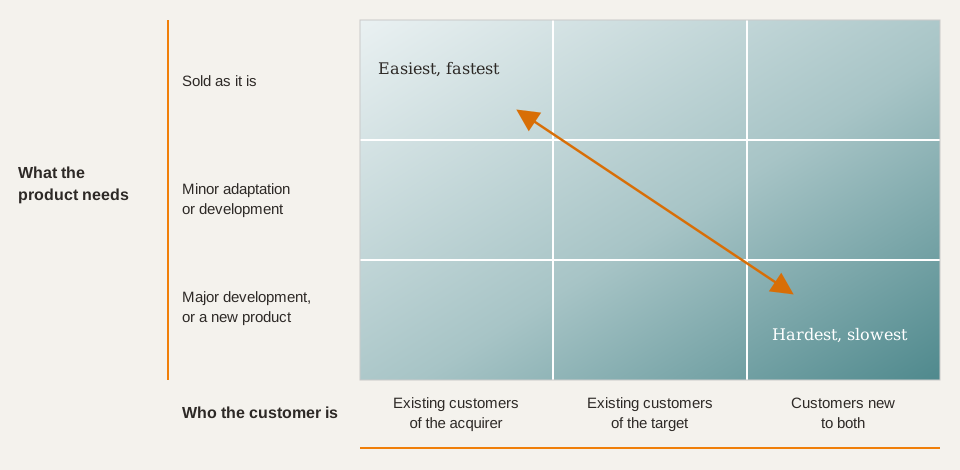
Each type gets its own probability and its own lead time. Selling an existing product to your own customer takes months. Adjusting a product for someone else's customer takes years, and often does not happen. A single percentage across all of them hides where the value sits. Most of it usually sits in one or two types.
One group is left off the matrix on purpose: customers who already buy from both businesses. They have been playing two suppliers against each other. After the deal they have one supplier, and a reason to ask for a discount.
3. Build it account by account
Now the number, built up from the accounts.
For each opportunity type, list the accounts. For each account: what they buy today, from whom, on what contract, ending when. What would make them switch. Who holds the relationship. Then a probability and a date.
The revenue synergy is the sum of that list. Account, product, value, probability, timing. The finished list nearly always comes out smaller than the percentage, and later. The list is also the first version anyone can be held to.
4. Test it with the people who sell
The deal team built the list. The sales teams know whether it is true.
They know which buyer has a brother-in-law at the competitor. Which account left three years ago and is not coming back. Which product the customer tried once and returned.
Before completion, buyer and target may share only so much, and the work may need a clean team. Within those limits, put the list in front of the people who would have to sell it, on both sides. Ask them to mark it up.
Two things come back. The list gets shorter. And the names on it acquire owners. Our grid's higher answer asks for exactly that: "Each revenue and cost synergy has a mechanism, an owner and validated assumptions."
5. Design the model that will deliver it
A validated list still delivers nothing on its own. Someone has to sell it, and they have to want to.
Decide who owns each account after the deal. One salesforce or two. Who sells the target's products: your people, their people, or specialists who support both.
Train the people who will carry a product they have never sold. Set the price and the terms for the combined offer. Give marketing something to say to the customers on the list.
Then the incentive. A salesperson who is not paid to sell the other company's product will not sell it. They have a quota on their own products and a quarter to hit. If the plan pays the same either way, the cross-sell is the first thing dropped. The synergy enters the case when it enters the commission plan.
What this does to the price
A revenue synergy built this way is smaller and later than the percentage, with a probability on it. It is also yours. No other bidder has your customers, so no other bidder can deliver it.
The argument for keeping it out of the price rests on that. Pay for the business as it stands, plus the savings any owner would make. The cross-sell is your return for doing the work above. The seller is not going to do any of it.
The top answer on the grid reads: "The synergies are proven: piloted, precedent-backed, or already visible in a partnership." If there is time before the bid to run one account list past one sales team, that is the pilot.
Updated 2026-09-26.